
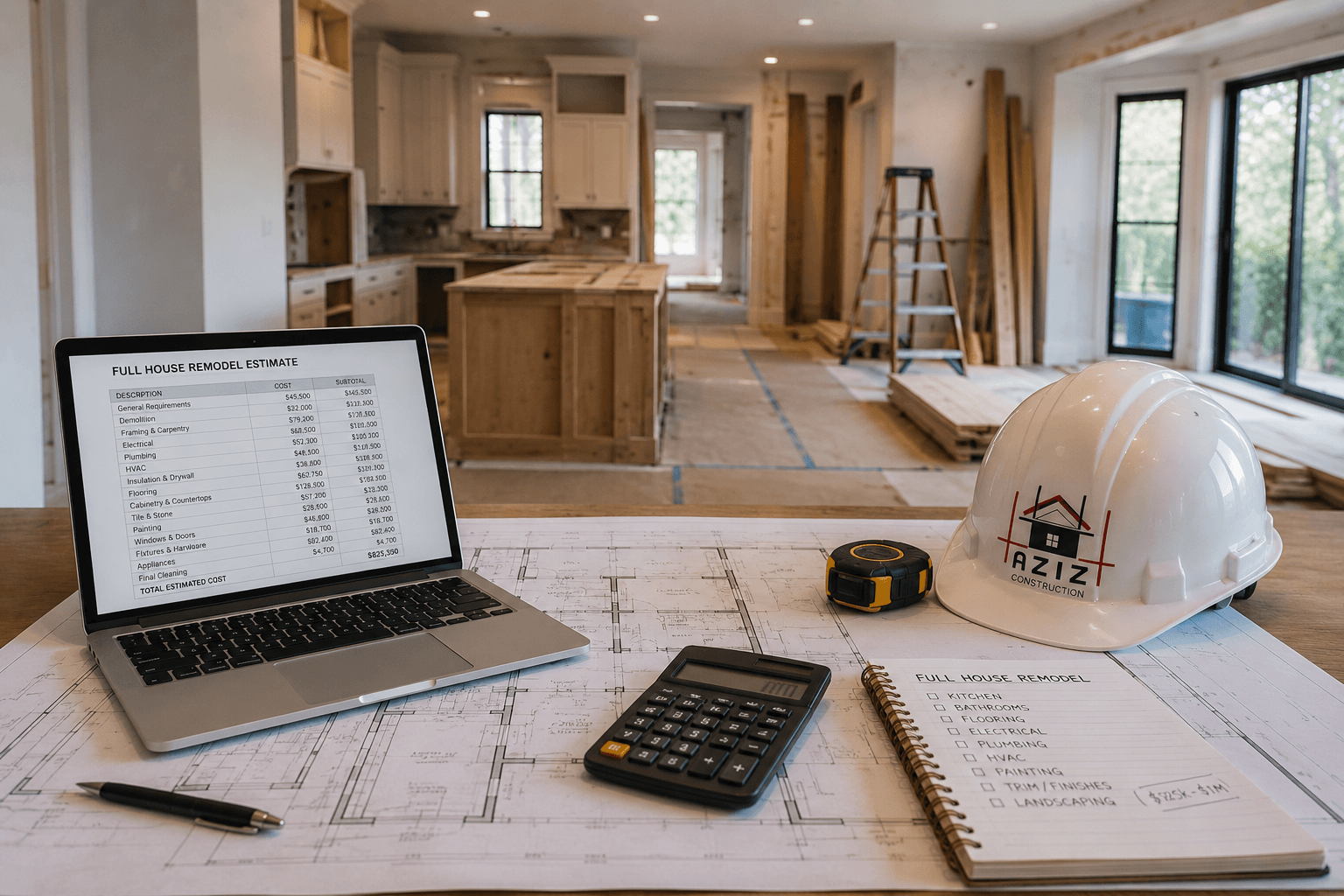
Whole home renovation cost is one of the first things Bay Area homeowners search when they start thinking seriously about remodeling. And for good reason, the number matters before any conversation about design, timeline, or contractor selection can happen.
The honest answer is that full house remodeling costs in the San Francisco Bay Area vary enormously. A 1,500-square-foot home in East Palo Alto and a 4,000-square-foot property in Menlo Park are entirely different financial undertakings, even if both homeowners describe the project as a "full remodel." Scope, finish level, structural complexity, permit jurisdiction, and existing conditions all drive cost in ways that a single price range can't capture.
What this guide does is break down the real cost drivers for full home remodel budgets in the Bay Area, give you realistic numbers tied to scope and finish level, and help you understand what separates a $300,000 remodel from one that runs $800,000 — so you can plan intelligently before committing to anything.
What Does 'Full House Remodeling' Actually Include?
Before discussing dollars, it's worth defining scope, because "full house remodeling" means different things to different homeowners, and that ambiguity is the primary source of budget surprises.
At the lighter end, a whole home renovation might involve updating finishes throughout new flooring, fresh paint, updated fixtures, refreshed cabinetry, without touching the structural layout or major systems. This is sometimes called a cosmetic remodel, and while it's still a significant undertaking, the cost profile is fundamentally different from a structural renovation.
A true full home remodel typically includes some or all of the following: kitchen remodel, one or more bathroom remodels, living area updates, bedroom updates, flooring replacement throughout, electrical panel upgrade, plumbing updates, HVAC replacement or upgrade, window replacement, and potentially layout changes that involve moving walls or reconfiguring the floor plan. Some projects also incorporate exterior work, siding, roofing, landscaping as part of a comprehensive renovation.
Understanding which of these components your project includes and to what finish standard is the essential starting point for any realistic California remodeling costs conversation.
Bay Area Remodeling Costs: Realistic Price Ranges by Scope
Bay Area remodeling costs are meaningfully higher than national averages, driven by above-market labor rates, high material costs, complex permitting requirements, and the sheer cost of operating a construction business in this region. Here's how full home remodel budgets typically break down by scope in 2026.
Cosmetic or Light Renovation
For homeowners updating finishes without structural changes, flooring, paint, fixtures, basic kitchen and bath updates, full house remodeling costs typically fall in the range of $150 to $300 per square foot in the Bay Area. On a 2,000-square-foot home, that puts a light renovation at roughly $300,000 to $600,000.
Even this "lighter" tier runs high by national standards. Bay Area labor rates for skilled tradespeople tile setters, cabinet installers, finish carpenters are significantly above average, and that cost shows up in every scope of work.
Mid-Scope Renovation with System Upgrades
A more comprehensive whole home renovation cost that includes kitchen and bath remodels at a mid-to-upper finish level, flooring replacement, electrical and plumbing updates, and moderate layout changes typically runs $300 to $500 per square foot. For a 2,000-square-foot home, that's a $600,000 to $1,000,000 project range numbers that often surprise homeowners who haven't done one before.
Much of this cost is invisible. Electrical panels in older Bay Area homes frequently need full replacement to meet current code. Plumbing in homes from the 1960s through the 1980s is often cast iron or galvanized steel that requires replacement. These are costs that don't show up in the finishes but add meaningfully to the total.
High-End or Luxury Home Renovation Pricing
Luxury home renovation pricing in the Bay Area projects with premium appliances, custom cabinetry, high-end stone surfaces, smart home integration, structural layout changes, and fine finish work typically starts at $500 per square foot and can run to $700 or more on complex projects.
At this level, a 3,000-square-foot whole home renovation represents a $1.5 million to $2+ million commitment. These numbers reflect the cost of genuinely premium materials and the skilled labor required to install them to a high standard not padding or markup for its own sake.
What Drives Full House Remodeling Costs in the Bay Area
Understanding the cost drivers behind bay area remodeling costs helps homeowners make smarter decisions both about which elements to prioritize and where it's possible to manage costs without compromising the final result.
Kitchen and Bathroom Remodeling
These two spaces consistently represent the largest cost centers in any full home remodel budget. A kitchen remodel in the Bay Area at a mid-to-upper level typically runs $80,000 to $200,000 depending on size, layout changes, and finish selections. Primary bathroom remodels can range from $40,000 to $100,000+. Secondary bathrooms come in lower, but multiple bathrooms add up quickly.
If you're planning a comprehensive project that includes a full house renovation, understanding the per-room cost structure up front helps avoid budget shock midway through the design process.
Structural and Layout Changes
Opening up a floor plan, removing load-bearing walls, adding square footage through a room addition, or reconfiguring structural layouts adds cost that goes well beyond the visible work. Engineering fees, temporary shoring during construction, beam installation, and the ripple effect on adjacent systems (electrical, plumbing, HVAC) can add tens of thousands of dollars to a project that might look straightforward from the outside.
Bay Area seismic requirements add another layer. Significant structural work often triggers requirements for seismic upgrades that wouldn't apply to a cosmetic-only project.
MEP Systems: Electrical, Plumbing, and HVAC
Mechanical, electrical, and plumbing systems are among the least glamorous and most significant cost drivers in whole home renovation cost. Older Bay Area homes, particularly those built before 1980, frequently require complete electrical panel replacement and rewiring of multiple circuits. HVAC systems at end of life need replacement rather than repair. Plumbing updates in kitchens and baths often reveal supply lines and drain systems that need replacement throughout.
These aren't optional upgrades when the existing systems don't meet current code. They're required work and experienced contractors build these costs into their estimates rather than discovering them mid-project.
Permitting in Bay Area Cities
Permit timelines and fees vary significantly across Bay Area jurisdictions. San Francisco, Palo Alto, Menlo Park, and San Jose each have their own building departments with different processing times, plan check requirements, and inspection standards. Permit costs themselves rarely make or break a budget, but timeline delays caused by lengthy permit review cycles can add real costs particularly if material prices or subcontractor availability shifts during a long wait.
Working with a contractor who has active relationships with local building departments and knows how to structure permit packages correctly for each jurisdiction is a legitimate cost management tool, not just a convenience.
Finish Level and Material Selections
The difference between a $150 per square foot renovation and a $500 per square foot renovation is largely captured in finish selections. Custom cabinetry versus semi-custom. Marble versus quartz versus tile. Hardwood versus engineered flooring. High-end plumbing fixtures versus builder grade. These decisions compound across an entire home and have a larger cumulative impact on total California remodeling costs than most homeowners anticipate at the outset.
How to Build a Realistic Full Home Remodel Budget
Budgeting for a whole home renovation is genuinely difficult without construction experience, because most of the cost is in work that happens behind walls and beneath floors, not in the materials and finishes that are easy to price-shop. Here's how experienced homeowners approach it.
Start with a Design and Scope Document
Before getting contractor bids, invest in a design phase that produces a clear, detailed scope of work. Vague bids based on square footage or general descriptions produce vague results and a wide range of numbers that are impossible to compare meaningfully. A detailed scope document lets contractors price the same project, which produces apples-to-apples bids.
Aziz Construction's design and planning services integrate this process directly with construction planning, which typically produces more accurate estimates and fewer surprises during the build.
Build a Contingency Reserve
Every experienced project manager recommends a contingency reserve, and Bay Area remodeling makes this especially important. Older homes hide conditions that no one can see until demolition begins buried plumbing, non-standard framing, materials that didn't show up on any drawing. A 10 to 15 percent contingency reserve is a reasonable starting point for most full house remodeling projects; 20 percent is smarter for older homes or projects with significant structural scope.
Prioritize High-Impact Spaces
If the full home remodel budget needs to flex, the kitchen and primary bathroom are almost always the right places to concentrate investment. These spaces drive the most homeowner satisfaction and carry the strongest weight in resale value calculations. Secondary bedrooms and guest bathrooms can absorb more budget-conscious decisions without significantly impacting the overall result.
Separate Wants from Needs Early
The most effective way to manage California remodeling costs is to distinguish early between non-negotiable work (code compliance, system replacements, structural requirements) and elective upgrades (finish level, smart home features, premium appliances). Understanding which dollars are required versus chosen helps homeowners make informed trade-offs if the initial estimate comes in above budget.
Full House Remodeling vs. New Construction: Which Makes More Financial Sense?
Some Bay Area homeowners reach a point in the planning process where a full home remodel budget starts to approach the cost of new house construction. This is a genuine crossroads that deserves careful analysis.
New construction offers a blank slate with no hidden conditions, no compromises with existing layouts, full control over every system and finish from the ground up. For homes with significant structural deficiencies, awkward floor plans that can't be cost-effectively corrected, or conditions that would require essentially rebuilding most of the house, new construction sometimes represents better long-term value.
Remodeling, on the other hand, preserves an existing structure (and whatever equity is tied to it), avoids the complexity and cost of lot development, and typically delivers a livable result faster than new construction. For homes with sound bones and good fundamental layouts, remodeling usually wins on both cost and timeline.
The honest answer depends on the specific home, site, and homeowner goals which is why the analysis is worth doing with a contractor who has experience in both.
What You Get When You Invest in a High-Quality Bay Area Remodel
Luxury home renovation pricing in the Bay Area reflects a real market reality: skilled labor is expensive, premium materials cost more, and doing complex work correctly the first time requires experience that commands a premium.
But the return on a well-executed whole home renovation in the Bay Area market is also real. Quality remodels in desirable neighborhoods hold and appreciate value well. A professionally designed and constructed home one where the kitchen feels intentional, the primary bath feels like a retreat, and the overall finish level reflects current Bay Area market standards commands meaningfully better prices and sells faster than comparable unremodeled homes.
Beyond resale, there's the lived experience. A full home remodel done well isn't just a financial investment. For homeowners planning to stay in their home for ten or more years, the quality of daily life in a well-designed, properly functioning space has genuine value that doesn't show up in any spreadsheet.
If you're considering a kitchen remodeling or bathroom remodeling as part of a broader whole home project, those individual spaces often define how the entire renovation feels when complete which is why they deserve proportionate investment.
Frequently Asked Questions
What is the average cost of a full house remodel in the Bay Area in 2026?
Full house remodeling costs in the Bay Area range from approximately $150 to $700+ per square foot depending on scope and finish level. A mid-scope renovation on a 2,000-square-foot home typically falls between $400,000 and $800,000. Luxury home renovation pricing on larger homes at premium finish levels can exceed $1.5 million. These numbers are Bay Area-specific and reflect local labor rates, permitting complexity, and material costs.
Why are Bay Area remodeling costs so much higher than national averages?
Several factors compound to produce the Bay Area premium. Labor costs for skilled tradespeople are significantly above the national average. Material costs are elevated across the board. Permitting fees and the complexity of local building codes add cost and time. Insurance, licensing, and the cost of operating a construction business in California all contribute. The result is a market where even relatively modest renovations cost more than comparable projects in other regions.
How long does a full house remodel take in the Bay Area?
Timeline depends heavily on scope and the specific city's permit processing speed. A mid-scope whole home renovation typically takes 6 to 12 months from permit approval to completion. Larger projects or those with complex structural components can run 12 to 18 months. Pre-construction planning and permitting — before a hammer swings — often adds 2 to 4 months to the total project timeline.
What is a realistic contingency to budget for a full home remodel?
For a typical Bay Area whole home renovation, a 10 to 15 percent contingency reserve is a reasonable minimum. For older homes — particularly those built before 1980 — or projects that include significant structural work, 20 percent is a more realistic cushion. Hidden conditions discovered during demolition are normal in older homes, and a properly funded contingency prevents those discoveries from derailing the project.
Does a full house remodel increase home value in the Bay Area?
A well-executed whole home renovation in a desirable Bay Area neighborhood generally does increase property value, though the degree of recovery varies by neighborhood, market conditions, and the quality of the work. Kitchen and bathroom remodels typically produce the strongest returns. The Bay Area market's high baseline home values mean that premium finishes are more likely to be rewarded at resale than in lower-cost markets.
Should I stay in my home during a full house remodel?
For comprehensive whole home remodels — particularly those involving kitchen, multiple bathrooms, and major system work — most homeowners find that relocating during the active construction phase is worth the cost. Dust, noise, utility interruptions, and compromised access to core living spaces make the home genuinely difficult to inhabit during heavy construction. For lighter renovations that can be phased by area, staying in place is sometimes manageable.
Planning Your Full House Remodel: The Right Starting Point
The most common mistake Bay Area homeowners make in planning a whole home renovation is trying to get to a number before they have a scope. Budget and scope are inseparable — you can't meaningfully price a project that hasn't been defined, and any number you get without a detailed scope is a guess that will change.
The right starting point is a conversation with an experienced general contractor who works regularly in your city, understands what your home's existing conditions are likely to present, and can help you develop a realistic scope before committing to a budget. That conversation usually surfaces options — phasing approaches, finish trade-offs, structural alternatives — that you wouldn't discover any other way.
Aziz Construction works with Bay Area homeowners across Palo Alto, Menlo Park, San Jose, Foster City, San Mateo, and surrounding cities on full house remodeling projects at every scale. If you're beginning to think seriously about a whole home renovation, reach out to start the planning conversation.

