

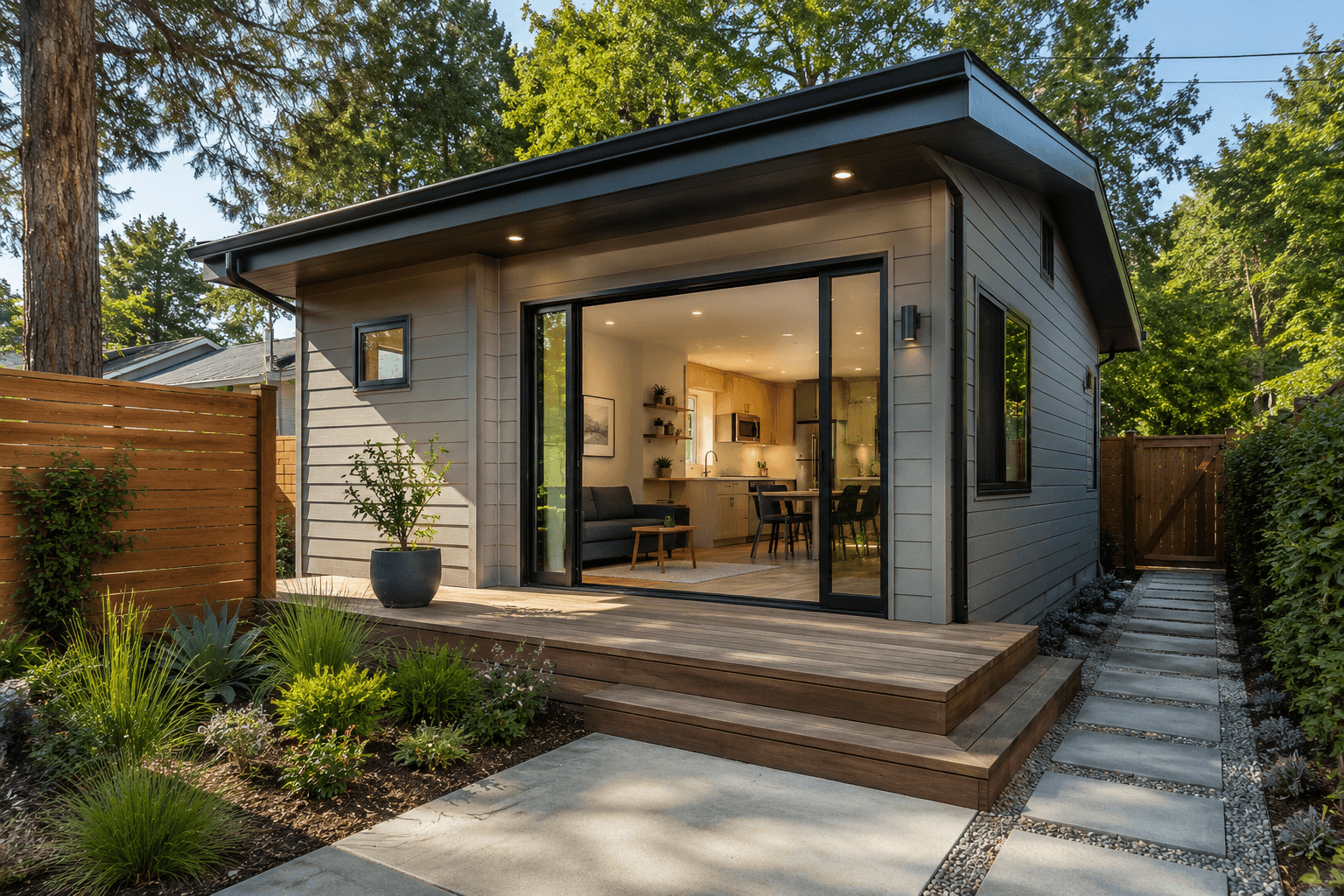
California has done more than any other state to open the door for homeowners who want to build ADUs. Starting around 2017 and accelerating through a series of legislative updates since then, the state systematically dismantled many of the local restrictions that previously made accessory dwelling unit construction slow, expensive, and uncertain. The result is a regulatory environment that, by national standards, is genuinely favorable for homeowners who want to add a unit to their property.
But favorable doesn't mean simple. California ADU law is also genuinely complex, with layers of state statutes sitting alongside local ordinances, overlapping exemptions and requirements, different rules for different ADU types, and ongoing legislative changes that have continued to shift the landscape year after year. Homeowners who go into an ADU project without understanding the regulatory framework often encounter surprises — not because the rules are hostile, but because they're detailed in ways that require careful navigation.
This guide breaks down the California ADU construction laws and state ADU regulations that matter most for Bay Area homeowners in 2026, covering permitted ADU types, size limits, setback rules, fee exemptions, the ministerial approval process, and the key points where local rules still have meaningful authority even under state law.
The Foundation: Why California Overhauled ADU Law
California's housing shortage is well documented. The state needs millions of additional housing units to meet demand, and single-family neighborhoods, which represent the majority of the state's residential land, have historically been restricted from adding density. ADU legislation was designed, in part, as a practical mechanism for adding housing capacity in existing neighborhoods without requiring major infrastructure investment or rezoning fights.
The state legislature pursued this goal by preempting local governments from applying many of the restrictions they had previously used to block or delay ADU projects. Cities and counties that had required large setbacks, imposed owner-occupancy requirements, mandated design review, or used other tools to limit ADU construction found those restrictions invalidated under state law. What replaced them was a framework of state ADU regulations that established maximum standards local governments must accept, while still leaving cities authority over some aspects of ADU regulation.
The practical effect for Bay Area homeowners is real: projects that would have been denied or heavily conditioned under local ordinances five or eight years ago are now approved ministerially, meaning without discretionary review, as long as they meet the state's objective standards. Understanding what those standards are is the core task for any homeowner evaluating an ADU project today.
ADU Types Recognized Under California Law
California law formally recognizes several distinct ADU types, each with its own set of rules, size limits, and fee structures. Understanding which type applies to your project is the first step in understanding the california ADU rules that govern it.
Standard ADUs
A standard ADU is a self-contained unit with its own kitchen, bathroom, and sleeping area, either newly constructed or created through conversion of existing space. Standard ADUs can be detached from the primary home, attached to it, or created by converting existing interior space or an existing accessory structure like a garage. Most of the ADU construction california discussion centers on standard ADUs because they're the most common and the most flexible.
Junior ADUs (JADUs)
A Junior ADU is a unit of no more than 500 square feet created entirely within the existing walls of the primary dwelling, typically by converting a bedroom, basement, or other interior space. JADUs are subject to distinct rules from standard ADUs: they can include an efficiency kitchen rather than a full kitchen, they share a bathroom with the primary dwelling or have their own, and they historically have been subject to owner-occupancy requirements. California law has continued to evolve on JADU owner-occupancy rules, so confirming the current requirement with a knowledgeable contractor or planning department is important before assuming anything.
Detached ADUs
Detached ADUs are freestanding structures, new construction, not conversions, located on the same lot as the primary dwelling. They're the most comprehensive ADU type from a construction standpoint, requiring their own foundation, structure, and full MEP systems. California law allows detached ADUs of up to 1,200 square feet in most circumstances, though some cities have adopted local standards that allow larger units where state law permits local flexibility.
Attached ADUs
An attached ADU shares at least one wall with the primary dwelling and may be built as an addition to the existing structure or created by converting an attached garage or other connected space. Attached ADUs can be up to 50 percent of the primary dwelling's square footage, up to a maximum of 1,200 square feet, under state law. The structural connection to the primary home introduces design and construction considerations that purely detached ADUs don't face.
Multiple ADUs on a Single Lot
One of the more significant provisions of recent california ADU rules is that most single-family lots can now have more than one ADU. Specifically, a property may have one standard ADU (detached or attached) plus one JADU simultaneously. This means a homeowner could build a detached ADU in the backyard while also converting a bedroom inside the primary home into a JADU, adding two units to a single-family property under state law.
Size Standards and Development Standards Under State Law
State adu regulations establish clear parameters for ADU size and development standards, what California calls "objective standards" that local governments must apply without using discretionary judgment to impose additional requirements.
Maximum Size Limits
For detached ADUs, California law allows units up to 1,200 square feet. For attached ADUs, the limit is 50 percent of the primary dwelling's living area, up to 1,200 square feet. Junior ADUs are capped at 500 square feet. These are state maximums; local jurisdictions can permit larger units if they choose, but cannot impose smaller limits than the state establishes.
There is also a provision in state law that allows a detached ADU of up to 800 square feet to be built regardless of lot coverage, floor area ratio, or other local ordinance limitations, a provision specifically designed to prevent local development standards from blocking smaller ADU projects that would otherwise comply with the state's framework.
Setback Requirements
Setback rules, the required distance between a structure and property lines are one of the areas where state law has been most explicit in limiting local authority. Under current california adu rules, cities and counties cannot require setbacks of more than four feet from the rear and side property lines for newly constructed ADUs. This standard applies specifically to prevent local governments from using large setback requirements to effectively prohibit ADU construction on lots where only a small area would remain buildable after applying generous setbacks.
Front yard setbacks are a different story state law allows local governments to apply the same front setback standards to ADUs that they apply to primary dwellings, which in many Bay Area cities means meaningful setbacks from the street-facing property line that can significantly constrain where a detached ADU can be sited on some lots.
Height Limits
State law has continued to increase permissible ADU heights in recent years. Detached ADUs within a half-mile of public transit can generally reach 18 feet in height, or up to two stories in some configurations. ADUs that are converting or replacing existing structures can match the height of the existing structure being converted. Many Bay Area properties fall within the half-mile transit proximity standard given the region's transit network density, which means the 18-foot height allowance applies broadly.
Lot Coverage and Floor Area Ratio
One of the more homeowner-friendly provisions in state adu regulations is the limitation on local governments' ability to use lot coverage ratios and floor area ratio (FAR) standards to block ADU construction. Specifically, a local agency cannot deny a permit for an ADU of up to 800 square feet based on lot coverage or FAR limitations alone creating a protected baseline that most lots can access regardless of how tight local development standards might otherwise be.
The Ministerial Approval Requirement: What It Means for Homeowners
One of the most practically significant provisions of California ADU law is the ministerial approval requirement. Under state law, local agencies must approve or deny an ADU application within 60 days of receiving a complete application and that approval must be ministerial, meaning it cannot involve discretionary review, design review boards, public hearings, or neighborhood notification processes.
What this means in practice: if your ADU project complies with the applicable objective standards under state law and local ordinance, the city must approve it. A neighbor can't appear at a hearing to object. A planning commissioner can't exercise judgment about whether the ADU is compatible with the neighborhood's character. An architectural review board can't require design changes based on subjective aesthetic preferences.
Where Local Authority Still Applies
Ministerial approval doesn't mean local governments have no role. Cities retain authority to enforce their own ADU ordinances in areas where state law permits local regulation, including design standards for ADUs visible from public streets (though these must be objective and cannot effectively preclude ADU construction), parking requirements in limited circumstances, and the application of local building codes.
Local governments also retain full authority over the building permit process itself. Meeting the planning and zoning standards for ministerial ADU approval is separate from obtaining a building permit, which requires full code-compliant construction documents, plan check review, and inspections throughout construction. The ministerial approval standard applies to the planning decision, not the building review process.
The 60-Day Clock and Incomplete Applications
The 60-day approval timeline begins when the local agency receives a complete accessory dwelling unit permits application. Agencies can issue an incomplete application notice that stops the clock until the homeowner provides the requested information. This creates an incentive for homeowners and their contractors to submit thorough, complete applications from the start — incomplete submissions that trigger repeated requests for additional information can significantly extend the effective timeline even within the 60-day framework.
Working with a contractor experienced in accessory dwelling unit construction in your specific city pays dividends here. Contractors who regularly submit ADU permit applications in a given jurisdiction understand exactly what plan checkers look for and what documentation the local agency considers a complete submission, producing faster approvals on average than first-time submissions from less experienced teams.
Fee Rules: What California Law Says About ADU Permit Costs
California law has progressively limited the fees that local agencies and utilities can charge for ADU projects, one of the more financially significant dimensions of state ADU regulations for homeowners doing budget planning.
Impact Fees
State law prohibits cities and counties from charging impact fees, transportation, parks, public facilities, and similar development fees, for ADUs under 750 square feet. For ADUs of 750 square feet or larger, impact fees must be proportional to the primary dwelling fee based on square footage, which typically produces a meaningfully lower fee than the full standard impact fee schedule.
School impact fees are separately governed. State law limits school impact fees on ADUs under 500 square feet to zero, and for larger ADUs, school districts must apply fees based on the square footage of the ADU rather than the full project. Given that school impact fees in Bay Area districts can run $5 to $10 per square foot, this limitation represents real savings on larger ADU projects.
Utility Connection Fees
Utilities, water, sewer, and sometimes electric, historically charged connection fees as if an ADU were a new primary dwelling, which dramatically increased ADU project costs. State law now limits utility connection fee amounts for ADUs that are converted from existing space and for ADUs that are built on properties that already have utility connections established through the primary dwelling. The specific fee limitations vary by utility and project type, but the general direction has been toward significantly reduced connection fees for qualifying ADU projects.
Permit Fees
Building permit fees for ADU projects are set by local building departments and are not as directly constrained by state law as impact fees. Bay Area cities vary considerably in their permit fee schedules for ADUs, from a few thousand dollars to upwards of $30,000 for larger, more complex projects. These fees are a real budget item and should be researched specifically for the city where your ADU will be built.
Owner-Occupancy Requirements: The Rule That Changed
For many years, California law allowed local governments to require that the property owner live in either the primary dwelling or the ADU as a condition of ADU approval. This owner-occupancy requirement was a meaningful constraint for homeowners who wanted to rent both units or purchase a property specifically as an investment vehicle.
State law eliminated local governments' ability to impose owner-occupancy requirements for standard ADUs from 2020 through 2025. Beginning January 1, 2025, this prohibition expired under the original statutory language, which created significant uncertainty about whether owner-occupancy requirements could be reimposed. The California legislature has subsequently addressed this through additional legislation, but the rules in this area have continued to evolve and homeowners should confirm the current owner-occupancy status in their specific city before finalizing project plans.
Junior ADUs have been subject to different owner-occupancy rules throughout this period and continue to have distinct requirements that vary from standard ADUs. Confirming the current JADU owner-occupancy rules in your jurisdiction is particularly important if you're considering a Junior ADU for rental purposes.
Parking Requirements: Largely Eliminated for Most ADU Projects
California law has significantly curtailed local governments' ability to require off-street parking spaces for ADUs. The general rule under state california adu rules is that no additional parking is required for ADUs that meet any of the following conditions: the ADU is within a half-mile of public transit; it's located within an architecturally and historically significant historic district; it's part of the existing primary residence; the on-street parking permit area does not require permits for the homeowner; or the ADU is located within one block of a car-share pickup location.
Given the Bay Area's transit network density, the half-mile transit proximity standard alone eliminates parking requirements for most ADU projects in the region. Homeowners in walkable, transit-accessible neighborhoods, which describes a significant portion of Bay Area residential properties, can generally plan ADU projects without allocating lot area for additional parking.
When an existing garage or carport is converted to an ADU and parking is lost as a result, the local agency cannot require replacement parking as a condition of approval. This was a specific loophole that some cities had used to effectively block garage conversions, and state law has closed it.
How Bay Area Cities Apply California ADU Law
While state law sets the floor for ADU regulations, the way individual Bay Area cities implement and administer those rules varies meaningfully in practice. Understanding the local context, not just the state framework, is essential for realistic ADU project planning.
Local ADU Ordinances
Most Bay Area cities have adopted local ADU ordinances that implement state law and, in some cases, provide additional flexibility beyond the state minimums. A city might allow ADUs up to 1,200 square feet even on smaller lots where the state's proportional limits would otherwise restrict size, or adopt a pre-approved ADU plan program that accelerates permit review for standardized designs. San Jose's ADU programs have historically been among the more streamlined in the region. San Francisco's ADU process remains the most complex, layered with additional planning requirements, tenant protections, and historic district considerations that don't apply in other cities.
Discretionary Review Risks
Even under the ministerial approval framework, some ADU projects in some Bay Area cities can become entangled in additional review processes, particularly if the property is in a historic district, a coastal zone, or subject to a specific plan with its own design standards. Understanding whether your specific property is subject to any overlay requirements that could complicate ministerial ADU approval is part of the due diligence that should happen before a design process begins.
Aziz Construction's team regularly assists homeowners with pre-construction planning services that include a thorough review of the specific regulatory context for a given property, city ordinance, zoning designation, any applicable overlays, and the practical realities of the local permit process, before any design investment is made.
ADUs and the Larger Property Strategy
Understanding california adu rules is important on its own, but ADU decisions rarely exist in isolation. For many Bay Area homeowners, the ADU question connects to broader questions about the property: whether a full house renovation makes sense alongside an ADU addition, whether the property's lot configuration supports the ADU type that best fits the homeowner's goals, and whether the regulatory environment in a given city makes one ADU type significantly more practical than others.
Some homeowners are also evaluating ADUs in the context of new construction projects — building a new primary residence and a detached ADU simultaneously, which tends to be more cost-efficient than building them sequentially and allows the two structures to be designed as a coherent property from the start.
These are decisions that benefit from experienced guidance, both on the regulatory side and on the construction side, from a team that works in these cities regularly and understands the practical implications of the regulatory framework, not just the text of the statutes.
Frequently Asked Questions
Does California state law override local ADU restrictions?
Yes, in most cases. California ADU law preempts local ordinances in several key areas, including setbacks, parking requirements, owner-occupancy requirements for standard ADUs, impact fees for smaller ADUs, and the ministerial approval requirement. Local governments cannot impose standards more restrictive than the state framework in these areas. However, cities retain authority over building code enforcement, some design standards, and local fee schedules not specifically limited by state law.
How large can an ADU be under California law?
Detached ADUs can be up to 1,200 square feet. Attached ADUs can be up to 50 percent of the primary dwelling's square footage, up to 1,200 square feet. Junior ADUs are capped at 500 square feet. State law also includes a provision that a detached ADU of up to 800 square feet cannot be blocked by local lot coverage or FAR restrictions, providing a guaranteed baseline for most lots.
Can I have both an ADU and a Junior ADU on the same lot?
Yes. California law allows a single-family property to have one standard ADU (detached or attached) plus one Junior ADU simultaneously. This means a homeowner could build a detached ADU in the backyard while converting an interior bedroom into a JADU, effectively adding two units to a single-family property.
Do I need owner-occupancy to build or rent an ADU in California?
The owner-occupancy rules for standard ADUs have changed multiple times in recent years and continue to evolve. As of 2026, homeowners should confirm the current rule in their specific city before planning a project around either occupying or not occupying the property. Junior ADUs may have different owner-occupancy requirements than standard ADUs. This is one of the specific areas where confirming current local rules, not just relying on a general summary, is genuinely important.
How long does it take to get an ADU permit in California?
State law requires cities to approve or deny a complete ADU permit application within 60 days. However, the clock begins on receipt of a complete application and cities can issue incomplete application notices that pause the timeline. In practice, permit timelines vary significantly by city: San Jose and San Mateo have generally faster processes; San Francisco routinely takes longer. Pre-construction planning that produces a complete, code-compliant permit package from the start is the most reliable way to minimize effective permitting time.
Are ADUs subject to rent control in California?
The intersection of ADU law and rent control is genuinely complex and city-specific. California's Tenant Protection Act of 2019 provides statewide rent increase caps for qualifying units but exempts single-family homes and ADUs rented by an owner who occupies the primary dwelling, among other exemptions. Cities with local rent control ordinances, like San Jose and East Palo Alto, may apply their local rules differently. Homeowners planning to rent an ADU should consult with a knowledgeable attorney or planning consultant about how rent control applies to their specific situation before proceeding.
Can unpermitted garage conversions be legalized as ADUs?
California law includes provisions specifically intended to facilitate the permitting of previously unpermitted ADUs and garage conversions. Cities cannot require unpermitted units to meet current development standards that didn't exist when the unit was constructed, and accessory dwelling unit permits for legalization of existing conversions are generally processed ministerially. The specific requirements and process for legalizing an existing unpermitted unit vary by city, but state law has generally made this path more accessible than it was under older regulatory frameworks.
Working Within the Framework: Where to Begin
California's ADU regulatory framework is genuinely more homeowner-friendly than it's ever been, but navigating it well still requires understanding both the state rules and how your specific city implements them. The homeowners who encounter the most friction in the ADU process are typically those who start with design before understanding the regulatory context, or who rely on outdated information about local rules that have since changed.
The right starting point is a property-specific review of what state law and your local ordinance permit on your lot, including ADU type, maximum size, setbacks, any applicable overlays, and the realistic permitting timeline in your city. From that foundation, design and budget planning can proceed on accurate information rather than assumptions that may not reflect current california adu rules.
Aziz Construction works with Bay Area homeowners on ADU projects across Palo Alto, Menlo Park, San Jose, Foster City, San Mateo, and surrounding communities. Our team navigates the California regulatory framework and local permit processes regularly, which means we can help you understand what's actually achievable on your property before you invest in design, and deliver a compliant, well-built ADU project from permit application through certificate of occupancy.

